

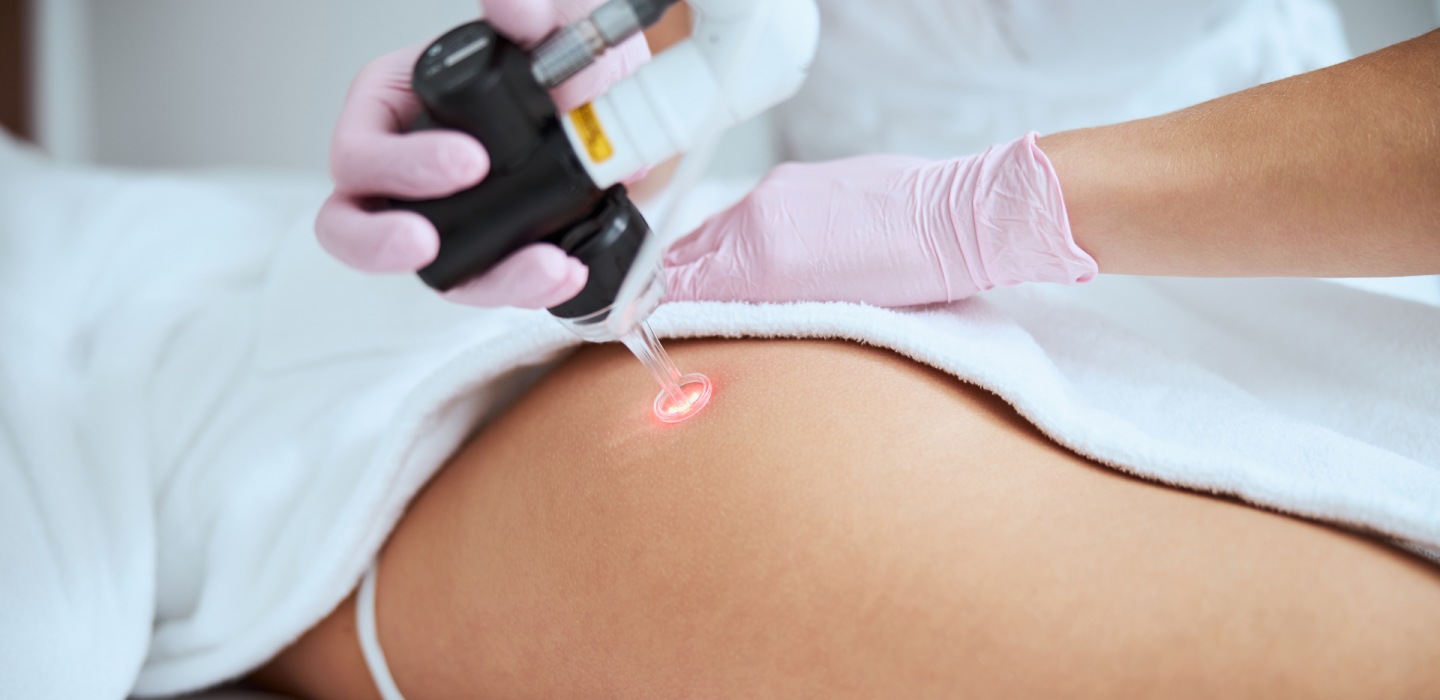
How Laser Treatments Help Reduce Stretch Marks
Stretch marks don’t fade easily, no matter how many creams you try. So can laser treatments actually help?
Yes. Laser treatments can significantly reduce the appearance of stretch marks by improving their color and smoothing their texture. They won’t erase them, but they can make them far less noticeable.
In this guide, you’ll learn how lasers work, what results to expect, and whether you’re a good candidate.
What Causes Stretch Marks?
Stretch marks, medically called striae distensae, are a form of dermal scarring. They are not just surface discoloration. They form when the deeper layer of the skin, the dermis, tears under tension.
Dermal Tearing and Collagen Breakdown
Your dermis contains collagen and elastin. These fibers give skin strength and flexibility.
When the skin stretches rapidly:
Collagen fibers rupture
Elastin weakens
The dermis thins
A scar-like line forms
This structural damage is why topical creams rarely fix established stretch marks.
Hormonal and Mechanical Triggers
Stretch marks are triggered by:
Pregnancy
Rapid weight gain or loss
Puberty growth spurts
Bodybuilding
Long-term corticosteroid use
Hormones like cortisol reduce collagen strength, making skin more vulnerable to tearing.
Early vs. Mature Stretch Marks (Striae Rubra vs. Striae Alba)
Stretch marks change over time.
Stage | Appearance | What’s Happening |
|---|---|---|
Striae rubra | Red, pink, purple | Active inflammation and visible blood vessels |
Striae alba | White or silver | Collagen loss and dermal thinning |
Early stretch marks usually respond better to treatment than older white ones.
The Science Behind Laser Treatment for Stretch Marks
Laser treatments do not scrape off stretch marks. They stimulate the body’s repair process. Instead of removing the scar, we encourage the skin to rebuild from within. That rebuilding is what improves texture and overall appearance over time.
Selective Photothermolysis Explained
Lasers work using a principle called selective photothermolysis.
This means:
A specific wavelength targets specific tissue
Controlled heat is delivered
Surrounding skin remains largely unaffected
For red stretch marks, lasers target blood vessels. For white stretch marks, they stimulate deeper tissue remodeling.
Controlled Thermal Injury and Tissue Remodeling
Laser energy creates tiny, controlled zones of heat in the skin.
Your body responds by:
Activating fibroblasts
Producing new collagen
Increasing elastin
Thickening the dermis
This process is called neocollagenesis, and it continues for weeks after treatment.
Collagen Stimulation and Neocollagenesis
Collagen rebuilding is gradual. Most patients begin noticing textural improvement within 4 to 6 weeks. Full remodeling may take 3 to 6 months.
In my clinical experience, texture improvement is usually the most satisfying result. The skin feels firmer and blends better.
How Lasers Improve Color and Texture
Laser treatments improve stretch marks in two key ways:
Color correction
Reduce redness in early stretch marks
Help white stretch marks blend with the surrounding skin
Texture refinement
Smooth depressed lines
Improve skin thickness
Create a more even surface appearance
Types of Lasers Used for Stretch Mark Reduction
Not all lasers work the same way. The right choice depends on the color of your stretch marks, how old they are, and your skin type.
A proper assessment helps match the technology to your specific concern.
Pulsed Dye Laser (PDL) for Red Stretch Marks
Best for early, red, or purple stretch marks.
Targets hemoglobin in blood vessels
Reduces visible redness
Minimal downtime
PDL works well when stretch marks are still in their active phase. It improves color more than texture.
Fractional CO₂ Laser for Deep Remodeling
Best for older white stretch marks.
Ablative laser
Creates microscopic treatment columns
Stimulates deep collagen production
This option delivers stronger collagen remodeling. Downtime may last 5 to 10 days, but improvement in texture can be more noticeable.
Fractional Er: YAG Laser for Surface Resurfacing
Less aggressive than CO₂
Improves texture
Shorter recovery period
This is often chosen for patients who want resurfacing with less downtime.
Non-Ablative Fractional Lasers for Collagen Stimulation
Common wavelengths include 1540 nm and 1550 nm.
Heat the dermis without removing the top layer
Minimal downtime
Gradual, steady improvement
These are popular for patients who cannot afford a longer recovery time.
Nd: YAG Laser for Darker Skin Types
Penetrates deeper into the dermis
Safer for Fitzpatrick IV to VI skin types
Lower risk of pigmentation changes
Choosing the correct wavelength is especially important for melanin-rich skin. Precision matters more than power.
Treatment Process and Recovery
Knowing what to expect makes the whole process feel less overwhelming. Laser treatment is straightforward, but understanding the steps helps you prepare mentally and practically.
What Happens During a Laser Session
A typical session looks like this:
The skin is cleansed
Numbing cream is applied if needed
Controlled laser pulses are delivered to the stretch marks
Soothing products are applied afterward
Sessions usually last 20 to 45 minutes, depending on the area treated.
Most patients describe the sensation as warmth or light snapping. It is tolerable, especially with numbing.
Number of Sessions Required
Stretch marks do not improve in one visit.
Most patients need:
3 to 6 sessions
Spaced 4 to 8 weeks apart
Older or deeper stretch marks may require more sessions. Consistency matters more than rushing.
Downtime and Healing Timeline
Recovery depends on the laser used:
Non-ablative lasers: 1 to 3 days of redness
Fractional CO₂: 5 to 10 days of visible healing
Redness and mild swelling are normal. Your skin may feel tight or slightly rough while it repairs itself.
Post-Treatment Care
After treatment, simple care makes a big difference:
Use SPF 30 or higher daily
Avoid direct sun exposure
Keep the area moisturized
Pause strong exfoliants for a short period
Sun protection is especially important. It protects both your skin and your results.
Expected Results and Limitations
Let’s keep this honest and clear.
Laser treatment improves stretch marks. It does not erase them.
What Improvements Are Realistic
Laser treatments can:
Reduce redness
Improve skin thickness
Smooth uneven texture
Help stretch marks blend better with the surrounding skin
In my experience, most patients see about 40 to 70% visible improvement after completing their full treatment plan. The biggest change is usually texture and overall blending, not complete disappearance.
How Long Results Take to Appear
Results are gradual.
Early changes may appear within 2 to 4 weeks
Collagen remodeling continues for up to 6 months
Your skin needs time to rebuild. Improvement builds session by session.
Why Stretch Marks Cannot Be Completely Erased
Stretch marks are dermal scars. Scar tissue is different from normal skin. Laser treatments remodel and thicken the area, but they cannot restore the original skin structure.
When patients understand this from the start, they feel more satisfied with their results. The goal is visible improvement, not perfection.
Who Is a Good Candidate for Laser Stretch Mark Treatment?
Laser treatment can help many people, but it is not a one-size-fits-all solution. The best results happen when your skin, health, and expectations all align.
This is why a proper consultation matters. We do not just look at the stretch marks. We look at you as a whole.
Ideal Skin and Stretch Mark Characteristics
You are generally a good candidate if you:
Have a stable weight
Are not currently pregnant
Do not have active skin infections
Understand that improvement is the goal, not total removal
Newer stretch marks, especially red or pink ones, usually respond faster. The skin is still active in that phase. Older white stretch marks can improve, too, but they often need more sessions and patience.
I always explain this clearly during consultations. If someone expects their stretch marks to disappear completely, I gently reset that expectation. When patients understand what is realistically possible, they are usually much happier with the outcome.
Fitzpatrick Skin Type Considerations
Skin tone plays a role in our laser choice.
Lighter skin types often have more flexibility in laser selection.
Darker skin types require more careful setting adjustments to avoid pigment changes.
This does not mean darker skin cannot be treated. It simply means experience and precision are even more important.
Medical Conditions and Contraindications
Laser treatment may need to be delayed or avoided if you have:
Conditions that affect wound healing
Recent isotretinoin use
Uncontrolled diabetes
Active skin infections
If you are recently postpartum, it is also wise to allow your hormones to stabilize first.
A good provider will ask detailed health questions before starting anything. If that conversation does not happen, that is a concern. Laser treatment should always be planned, not rushed.
Risks and Safety Considerations
Laser treatments for stretch marks are considered safe when performed by trained professionals. That said, this is still a medical procedure. Understanding possible side effects helps you make an informed decision instead of walking in blindly.
Most reactions are temporary and part of the normal healing response.
Common Temporary Side Effects
After treatment, it’s normal to experience:
Redness
Swelling
Mild warmth or tenderness
Temporary darkening of the treated area
These reactions usually settle within a few days. With ablative lasers like fractional CO₂, recovery can take up to a week. Skin may feel tight or slightly rough as it heals.
We always remind patients: redness does not mean damage. It means your skin is responding to controlled stimulation.
Pigment Changes and Rare Complications
More serious complications are uncommon but possible, especially if treatment is done improperly.
Rare risks include:
Hyperpigmentation (darkening)
Hypopigmentation (lightening)
Scarring
The risk is slightly higher in darker skin tones if incorrect settings are used. This is why laser selection and energy adjustment matter so much.
Importance of Professional Assessment
Laser results depend far more on the provider than the machine itself.
Successful treatment requires:
Correct wavelength selection
Proper energy settings
Depth control
Accurate assessment of your skin type and stretch mark stage
Experience matters. Judgment matters.
A thorough consultation should never feel rushed. You should understand the plan, the expected outcome, and the risks before starting. That’s how we approach it in our clinic.
Laser Treatment Compared to Other Options
Many patients compare treatments before deciding. That’s smart. Stretch marks affect the deeper dermis, so understanding how each treatment works helps you choose the right approach instead of wasting time or money.
Laser vs. Microneedling
Microneedling stimulates collagen mechanically by creating controlled micro-injuries with fine needles. This triggers the body’s natural healing response.
Laser treatments, on the other hand, use controlled thermal energy to reach specific depths with greater precision.
Key difference:
Microneedling is effective for mild texture issues.
Laser often provides stronger remodeling for deeper, more established stretch marks.
In practice, I’ve seen patients with shallow stretch marks respond well to microneedling. But for deeper, white stretch marks, laser typically delivers more noticeable improvement.
Laser vs. Radiofrequency Treatments
Radiofrequency (RF) treatments heat tissue without using light. The goal is still collagen stimulation.
Some modern devices combine microneedling with RF for enhanced effect.
Laser allows:
Targeted wavelengths
Precise depth control
Treatment of both color and texture
RF is helpful for skin tightening. Laser is often more effective when stretch marks require both pigment correction and deeper collagen remodeling.
In certain cases, combining treatments can enhance results, especially for mature stretch marks.
Laser vs. Topical Products
Topical creams improve hydration and strengthen the skin barrier. Ingredients like retinol may support mild collagen stimulation over time.
However, creams:
Do not reach deep dermal layers
Cannot rebuild torn collagen fibers
Cannot significantly thicken atrophic stretch marks
That’s why established stretch marks rarely respond dramatically to topical products alone.
And if you’ve already tried oils, cocoa butter, or expensive serums with little improvement, you’re not alone. Many of our patients say the same thing. It’s frustrating to apply something consistently and see almost no difference. The truth is simple. Stretch marks form deeper than most products can reach. It’s not about effort. It’s about biology.
Conclusion: Is Laser Treatment the Right Choice?
Laser treatments can significantly improve stretch marks by stimulating collagen, smoothing texture, and reducing discoloration. While they cannot erase them, they can create visible, confidence-boosting changes with the right plan.
At Hailey’s Hair Removal & Aesthetics, we carefully assess your skin type, stretch mark stage, and goals to choose the safest, most effective laser approach for you. Our focus is honest guidance, personalized treatment, and realistic results you can feel good about.
Frequently Asked Questions
Can stretch marks be completely removed?
No. Stretch marks are a form of dermal scarring, so they cannot be fully erased. However, laser treatments can significantly improve their color, texture, and overall visibility with multiple sessions.
Is laser treatment painful?
Most patients describe a mild heat or snapping sensation during treatment. Discomfort is generally manageable, and numbing cream is applied beforehand to improve comfort.
Is it safe for darker skin?
Yes, when the correct wavelength and settings are used. Experienced providers select lasers carefully to reduce the risk of pigmentation changes in melanin-rich skin.
How soon after pregnancy can treatment begin?
Treatment usually begins after hormones stabilize and once breastfeeding considerations are addressed. Medical clearance is recommended to ensure your body has fully recovered.
Related Articles