

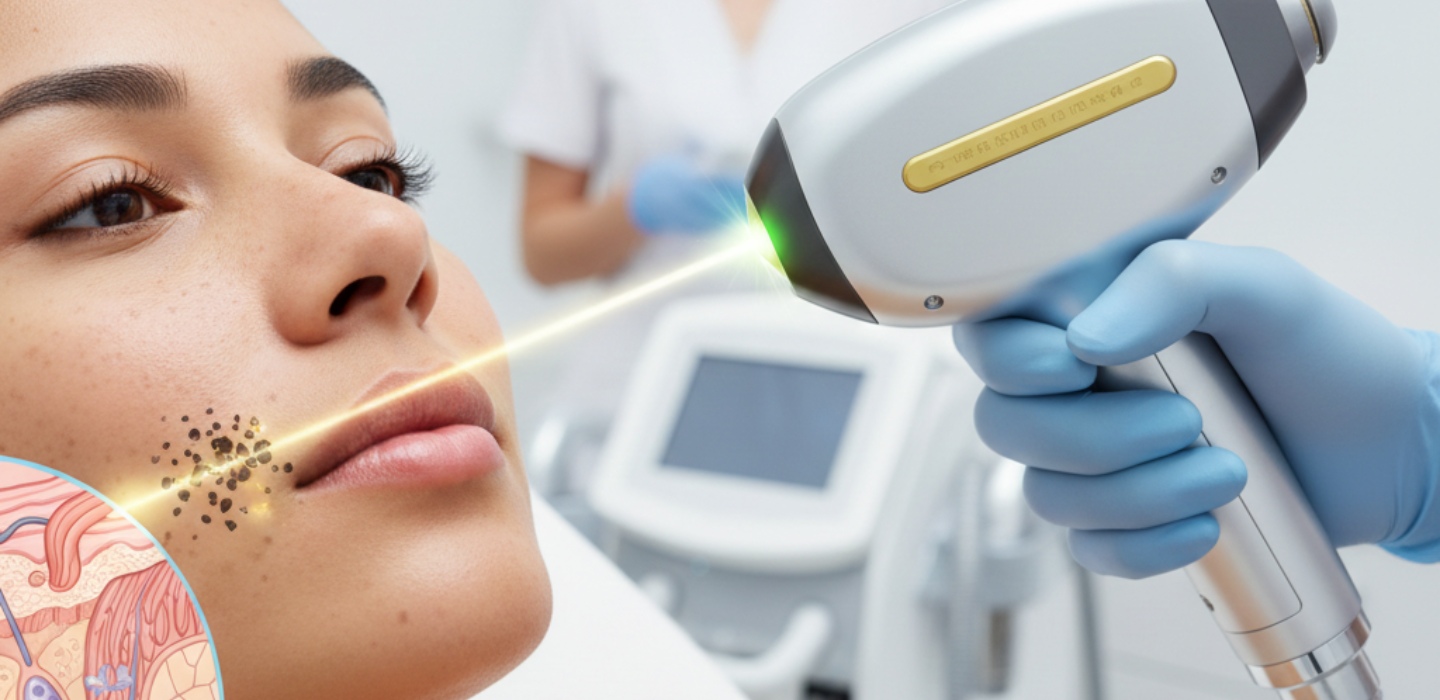
How Laser Treatments Target Pigmentation Safely
Dark spots can be frustrating. You try creams. You wear sunscreen. Yet the pigment often lingers.
So here’s the direct answer: yes, laser treatments can safely and effectively target pigmentation when performed correctly. Laser technology uses precise light energy to break down excess melanin without harming surrounding skin.
In this guide, you’ll learn how laser works, the science behind selective photothermolysis, the safety protocols involved, and why it’s often preferred over creams or peels.
Understanding Pigmentation and Why It Develops
Pigmentation is not random. It is your skin responding to triggers like sun exposure, hormones, or inflammation. To treat it safely and effectively, we first need to understand how and where that excess pigment forms.
The Role of Melanin in Skin Color
Melanin is the pigment that gives your skin its color. It’s produced by cells called melanocytes. Its main job is protection. It absorbs UV radiation and shields deeper skin layers.
When melanin production becomes uneven or overstimulated, visible discoloration appears.
Common Types of Pigmentation
Here are the most common concerns we treat:
Type | Cause | Depth | Laser Response |
|---|---|---|---|
Solar lentigines | UV exposure | Superficial | Responds well |
Melasma | Hormones + UV | Deeper + vascular | Requires careful settings |
Post-inflammatory hyperpigmentation (PIH) | Acne, injury | Variable depth | Needs customized approach |
Freckles | Genetic | Superficial | Often clears quickly |
Different pigment types require different strategies. That’s why proper diagnosis matters before choosing any treatment.
Why Surface Treatments May Not Be Enough
Topical creams mainly work at the surface. But some pigment sits deeper, below the epidermis.
If pigment is embedded in the dermis, creams may lighten slowly or stop improving altogether.
Laser energy, however, can reach those deeper targets with precision.
The Science Behind Laser Pigmentation Removal
Laser treatment is not guesswork. It is based on established medical physics that allows us to target pigment precisely while protecting the surrounding skin. Understanding this science helps explain why lasers can be both effective and safe.
What Is Selective Photothermolysis?
The foundation of laser treatment is a principle called selective photothermolysis.
Let’s break it down clearly:
Selective = targets a specific structure
Photo = light
Thermo = heat
Lysis = destruction
In simple terms, a specific wavelength of light is absorbed by melanin. That absorbed energy turns into heat. The heat fragments the pigment while surrounding tissue remains largely unaffected.
That precision is what makes modern laser treatment controlled rather than destructive.
How Specific Wavelengths Target Melanin
Different laser devices use different wavelengths because melanin absorbs certain light frequencies more efficiently than others.
During treatment:
The laser emits a calibrated wavelength.
Melanin absorbs that light energy.
The energy converts into heat.
The heat breaks the pigment into smaller fragments.
This is targeted energy delivery — not random skin damage.
How the Body Clears Fragmented Pigment
Once the pigment is broken into smaller particles, your body takes over. The lymphatic system gradually removes the debris over time.
That’s why you may notice:
Spots darkening temporarily
Mild flaking
Gradual fading over 2–6 weeks
Results develop progressively as your body clears the treated pigment.
Types of Lasers Used for Pigmentation
Not all pigmentation lasers are the same. Each device differs in pulse duration, energy delivery, and how it interacts with melanin. Choosing the right system depends on your skin type, pigment depth, and treatment goals.
Q-Switched Lasers
Q-switched lasers have been used for decades and remain a reliable option for treating superficial pigmentation.
They:
Deliver high energy in nanoseconds
Target melanin efficiently
Are commonly used for sun spots and freckles
Because of their short pulse duration, they limit heat spread to surrounding tissue. This makes them predictable and well-studied in pigmentation treatment.
Picosecond Lasers
Picosecond lasers represent a newer advancement in laser technology.
They:
Deliver ultra-short pulses in picoseconds
Reduce heat diffusion
Break pigment into even smaller fragments
The shorter pulse creates more mechanical disruption and less thermal injury. This makes picosecond systems particularly useful for stubborn pigmentation and for patients where minimizing heat is important.
Fractional Lasers
Fractional lasers work differently. Instead of targeting isolated pigment particles alone, they create controlled micro-injuries in the skin.
They:
Form microscopic treatment zones
Stimulate collagen production
Improve both pigmentation and texture
If you have acne scars combined with post-inflammatory hyperpigmentation, fractional systems can address both issues in the same session.
Built-In Safety Mechanisms of Laser Technology
Safety is a common concern, especially when treating pigmentation. The good news is that modern laser systems are engineered to protect surrounding skin while precisely targeting melanin.
Precision Wavelength Selection
Laser safety starts with choosing the correct wavelength.
We select wavelengths based on:
Pigment depth
Skin tone
Type of discoloration
Because melanin absorbs specific light frequencies, selecting the right wavelength ensures the energy is directed toward pigment, not healthy tissue. This reduces unnecessary thermal damage.
Controlled Pulse Duration
Pulse duration determines how long heat is delivered to the target.
Shorter pulses:
Limit heat diffusion
Confine energy to pigment
Reduce the risk of scarring
Matching pulse duration to the pigment’s thermal properties allows for controlled fragmentation instead of uncontrolled heating. This is applied physics, not guesswork.
Integrated Cooling Systems
Modern devices also include built-in skin protection.
Common cooling methods include:
Contact cooling tips
Cryogen spray
Forced cold air systems
Cooling protects the epidermis while allowing deeper pigment to absorb energy. This balance is what allows treatment to remain both effective and safe.
Clinical Safety Protocols That Reduce Complications
Advanced technology is only part of the equation. Safe and effective laser pigmentation treatment depends heavily on clinical assessment, customization, and proper aftercare.
Skin Assessment and Fitzpatrick Typing
Before any laser session, we evaluate your Fitzpatrick skin type, medical history, and pigmentation pattern.
Why this matters:
Darker skin contains more baseline melanin. If energy levels are too high, the risk of post-inflammatory hyperpigmentation increases.
Correct assessment allows us to minimize that risk from the start.
Customizing Energy Settings by Skin Tone
Laser treatment is never one-size-fits-all.
For darker or more reactive skin types, we may:
Use lower fluence (energy levels)
Increase spacing between sessions
Adjust pulse duration
These adjustments help reduce inflammation while still targeting pigment effectively.
Pre-Treatment Skin Preparation
Preparation improves safety and outcomes.
Before treatment, we typically recommend:
Avoiding tanning or recent sun exposure
Stopping retinoids 5–7 days prior
Using daily broad-spectrum SPF
Recently sun-exposed skin absorbs more energy and increases the risk.
Post-Treatment Care and Sun Protection
After treatment, proper care is essential.
We advise:
Daily SPF 50+
Avoiding intense heat and workouts for 48 hours
Not picking or peeling darkened spots
Consistent sun protection reduces rebound pigmentation and preserves results.
Who Is an Ideal Candidate for Laser Pigmentation Treatment?
Not every dark spot should be treated the same way. The best results happen when the right patient, the right diagnosis, and the right laser settings align.
You may be a strong candidate if:
Your pigmentation is stable (not actively worsening or hormonally fluctuating)
You consistently use sunscreen and are willing to continue long-term
Your skin is not recently tanned or sunburned
You are not pregnant or breastfeeding (especially in cases of melasma)
You have realistic expectations about gradual improvement
You understand that melasma may require maintenance treatments
Ideal candidates also understand that laser improves pigment, but lifestyle plays a major role in maintaining results.
I’ve seen great results fade when sunscreen wasn’t consistent. In those cases, we pause and focus on strict SPF and skin protection first. Laser works best when your skin is protected. A proper consultation helps us choose the safest and most effective treatment for your specific pigmentation.
What to Expect During and After Treatment
If you’re considering a laser, it helps to know what the experience actually feels like and how your skin will respond afterward. Most pigmentation treatments are straightforward, but understanding the timeline prevents unnecessary worry.
During the Procedure
The session itself is usually quick and manageable.
You can expect:
A sensation similar to light snapping or tiny elastic bands
Treatment time of about 15–30 minutes, depending on the area
Minimal discomfort for most patients
Cooling systems are often used during treatment to protect the skin and improve comfort.
Immediate Post-Treatment Changes
Right after your session, your skin will react, and that’s normal.
Common short-term changes include:
Mild redness
Slight warmth in the treated area
Darkening of the pigmented spots
That temporary darkening is actually a positive sign. It means the pigment has absorbed the energy and is beginning to break down.
Healing and Fading Timeline
Pigmentation fades in stages. Here’s a realistic timeline:
Timeline | What Happens |
|---|---|
Days 1–3 | Pigment darkens |
Days 5–10 | Light flaking or crusting |
Weeks 2–6 | Gradual visible fading |
Deeper pigment may require multiple sessions spaced several weeks apart. Improvement builds progressively as your body clears the fragmented pigment.
Risks and Limitations of Laser Pigmentation Treatment
Laser pigmentation treatment is generally safe when performed correctly, but it’s important to understand possible risks and limits.
Common temporary reactions include:
Redness lasting a few hours to a few days
Mild swelling
Temporary darkening of treated spots
Rare blistering, usually from overly aggressive settings
A key risk is post-inflammatory hyperpigmentation (PIH), where the skin produces extra pigment after inflammation. This is more common in darker skin tones or when aftercare is not followed.
There are also limitations. Laser removes existing pigment, but it does not eliminate triggers. For example, melasma can recur, especially without strict sun protection.
Proper assessment, conservative settings, and good aftercare significantly reduce complications.
Why Laser Is a Preferred Option for Pigmentation Removal
With many treatment options available, it’s fair to ask why laser is often recommended. The answer comes down to precision, depth, and control.
Targeted Treatment of Pigment
Laser energy is designed to specifically target melanin, the pigment causing discoloration. Instead of affecting the entire skin surface, it focuses on the darkened areas, allowing surrounding tissue to remain largely untouched.
Precision Compared to Peels and Topicals
Chemical peels and topical creams treat broader areas of skin. While helpful, they are less selective.
Laser, on the other hand, can treat individual spots or deeper pigment, making it especially useful when discoloration is localized or resistant to creams.
Predictable Results with Proper Protocol
When performed with appropriate settings and followed by consistent sun protection, laser treatments produce reliable, measurable improvement. The key is correct diagnosis, customized parameters, and disciplined aftercare.
Laser vs Other Pigmentation Treatments
Different pigmentation treatments work at different depths. Choosing the right one depends on how deep the pigment is and how targeted the treatment needs to be.
Treatment | Target Depth | Precision | Downtime |
|---|---|---|---|
Laser | Medium–Deep | High | Low–Moderate |
Chemical Peels | Superficial–Medium | Moderate | Moderate |
Topicals | Superficial | Low | None |
Topicals help with mild surface discoloration but require time and consistency.
Chemical peels improve the broader surface pigment.
Laser targets deeper, stubborn spots with greater precision.
Each option has value, but for resistant or deeper pigmentation, laser offers the most targeted approach.
Practical Tips From Our Clinic
If you’re considering laser:
Do not treat freshly tanned skin
Request a full skin assessment
Commit to sunscreen long-term
Avoid “discount laser deals” without medical oversight
We always tell our patients: Your results depend more on sun protection after treatment than on the laser itself.
Final Thoughts: Precision, Science, and Safe Outcomes
Laser treats pigmentation safely by using specific wavelengths that target melanin while protecting surrounding skin. The key to good results is proper diagnosis, customized settings, and strict aftercare.
Laser is not about burning skin. It’s controlled, precise light energy guided by science and experience.
At Hayley’s Hair Removal and Aesthetics, we use advanced technology and personalized treatment plans to safely reduce stubborn pigmentation while prioritizing your long-term skin health.
Related Articles