

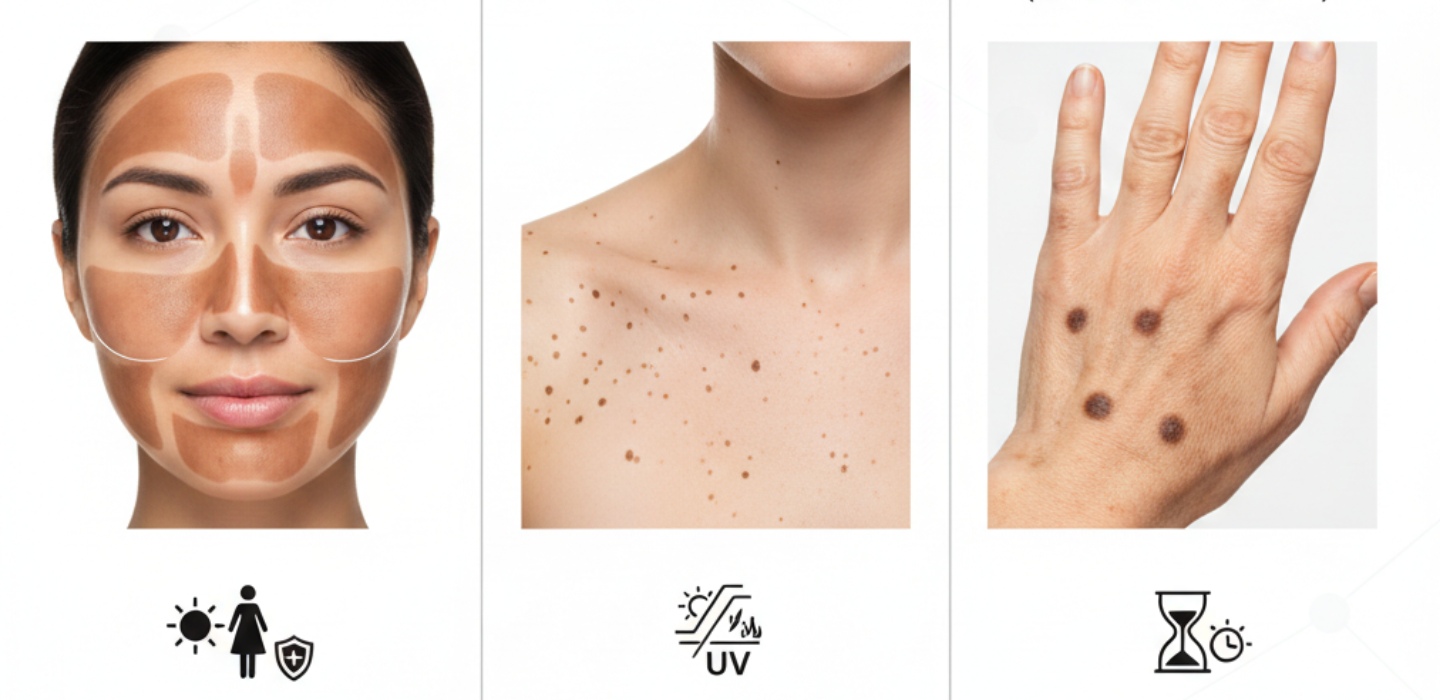
Understanding Different Types of Pigmentation: Melasma, Sun Damage, Age Spots
Have you started seeing dark patches, sunspots, or uneven skin tone — and wondering what’s causing them? Is it melasma? Sun damage? Age spots? Or something else entirely?
Pigmentation can be confusing because many conditions look alike but behave very differently beneath the surface. Melanin production, UV exposure, hormonal fluctuations, and inflammation all play a role — yet each type requires a tailored treatment strategy.
In this comprehensive guide, we explain how pigmentation forms, why it develops, and how to treat it safely using evidence-based skincare and professional aesthetic treatments.
Our goal is simple: to help you understand your skin with clarity and restore confidence through informed decisions.
What Is Skin Pigmentation and How Does Melanin Affect Skin Tone?
Skin pigmentation is the natural colouring of your skin, determined by melanin — a protective pigment produced by melanocytes.
Melanin helps defend against UV radiation, but when production becomes irregular, it can lead to hyperpigmentation (dark patches) or hypopigmentation (lighter areas).
Overactivity of tyrosinase, the key enzyme in melanin synthesis, contributes to uneven skin tone, dark spots, and visible discolouration.
Common causes of hyperpigmentation include:
UV exposure: Stimulates melanocytes and increases melanin production
Hormonal changes: Pregnancy, oral contraceptives, or hormonal fluctuations can trigger melasma
Post-inflammatory hyperpigmentation (PIH): Acne, eczema, or skin trauma can leave residual dark marks
Genetics and Fitzpatrick skin types: Higher phototypes are more prone to pigment changes
Inflammation and oxidative stress: Free radicals activate tyrosinase, worsening uneven pigmentation
Understanding these triggers allows for targeted, evidence-based treatment and better long-term skin management.
What Is Melasma? Symptoms, Triggers, and Hormonal Links
Melasma, often called chloasma or the “pregnancy mask”, is a chronic form of hyperpigmentation triggered by hormonal changes and UV exposure.
Fluctuations in estrogen and progesterone overstimulate melanocytes, increasing melanin production and causing symmetrical brown or grey-brown patches. It most commonly affects Fitzpatrick skin types III–V and tends to worsen with sun exposure.
Melasma typically appears on the cheeks, upper lip, forehead, and jawline, though it can also develop on the neck or forearms. Epidermal melasma sits closer to the skin’s surface and responds more readily to treatment, while dermal melasma lies deeper and may require more advanced, professionally guided therapies for effective management.
Understanding Sun Damage and UV-Induced Pigmentation
Sun damage develops from repeated exposure to UVA and UVB rays.
UVA penetrates deeper into the skin, accelerating photoaging and contributing to solar elastosis, while UVB affects the surface and directly stimulates pigment production. Together, they activate melanocytes, leading to freckles, sunspots, and uneven skin tone — particularly without consistent broad-spectrum SPF protection.
Over time, cumulative UV radiation damages skin cell DNA and generates free radicals, creating oxidative stress. This process stimulates tyrosinase and increases melanin synthesis, resulting in persistent dark spots and visible texture changes.
Daily sun protection isn’t optional — it’s essential for preventing and managing UV-induced pigmentation.
What Are Age Spots (Liver Spots)? Causes and Appearance
Age spots, also known as solar lentigines or “liver spots”, are flat brown, black, or grey marks that develop gradually on sun-exposed areas of the skin.
Unlike freckles, they don’t fade in winter and tend to become more noticeable with age. They usually have a uniform colour and clearly defined borders, but any new or changing lesion should always be professionally assessed to rule out serious conditions such as melanoma.
Common causes of age spots include:
Cumulative UV exposure: Long-term sun exposure overstimulates melanocytes
Photoaging: Chronic UVA damage accelerates pigment clustering
Age-related skin changes: Slower cellular turnover allows pigment to accumulate
Inconsistent sun protection: Lack of daily broad-spectrum SPF increases risk
Prevention and early management can significantly reduce their appearance over time.
Melasma vs Sun Damage vs Age Spots: Key Differences Explained
Feature | Melasma | Sun Damage (UV-Induced Pigmentation) | Age Spots (Solar Lentigines) |
|---|---|---|---|
Main Trigger | Hormonal changes + UV exposure | Chronic UV exposure | Cumulative UV exposure over time |
Appearance | Symmetrical brown/grey patches | Diffuse uneven tone, freckles, sunspots | Isolated, well-defined flat brown spots |
Common Areas | Cheeks, upper lip, forehead, jawline | Face, chest, shoulders, hands | Face, hands, shoulders, arms |
Pigment Depth | Epidermal or dermal | Primarily epidermal | Epidermal |
Behaviour | Chronic, can flare with hormones | Worsens with sun exposure | Gradually darkens and persists |
Post-Inflammatory Hyperpigmentation (PIH): Another Common Pigment Concern
Post-inflammatory hyperpigmentation (PIH) develops after your skin experiences inflammation — such as acne breakouts, eczema, cosmetic procedures, or minor trauma.
As the skin heals, the inflammatory response overstimulates melanocytes, leading to excess melanin production and lingering dark marks where the injury occurred.
PIH can affect all skin tones but is more common and often more persistent in darker Fitzpatrick skin types due to naturally higher melanin activity.
The good news is that early intervention, gentle skincare, and strict daily sun protection can significantly reduce its duration and prevent further discolouration.
Evidence-Based Treatments for Melasma, Sun Damage, and Age Spots
The most effective treatment for pigmentation depends on what type you have, how deep the pigment sits, and your individual skin type. Because melasma behaves differently from age spots or general sun damage, a tailored approach is essential for safe, long-lasting results.
Common evidence-based treatment options include:
Topical hydroquinone: Gold-standard pigment suppressor that reduces melanin production
Retinoids (vitamin A derivatives): Increase cell turnover and improve uneven skin tone
Azelaic acid: Anti-inflammatory and tyrosinase inhibitor, helpful for melasma and PIH
Tranexamic acid: Regulates pigment pathways, particularly effective for melasma
Chemical peels: Accelerate exfoliation and target superficial pigmentation
Laser therapies (Q-switched lasers, IPL): Break down excess pigment in selected cases
A professional skin assessment ensures the right treatment plan — especially for melasma-prone or darker skin types, where incorrect protocols can worsen pigmentation.
Preventing Pigmentation: Sun Protection and Long-Term Skin Care Strategies
When it comes to pigmentation, prevention is just as important as treatment. Even the most advanced procedures won’t deliver lasting results without consistent protection and maintenance.
Protecting your skin daily helps prevent melanin overproduction, recurrence of dark spots, and long-term photoaging.
Key strategies include:
Daily broad-spectrum sunscreen (SPF 30+ or higher): Protects against UVA, UVB, and visible blue light
Regular reapplication: Every two hours when outdoors, and after sweating or swimming
Topical antioxidants (e.g., vitamin C): Help neutralise free radicals and reduce oxidative stress
Protective clothing and wide-brim hats: Minimise direct UV exposure
Consistent skincare routine: Supports barrier health and maintains treatment results
Long-term consistency is what keeps pigmentation controlled and your skin tone even.
When to See a Skin Specialist for Persistent Pigmentation
If you notice pigmentation that changes quickly, becomes asymmetrical, develops irregular borders, or doesn’t respond to over-the-counter treatments, it’s important to seek professional assessment.
Conditions like resistant melasma or recurring dark spots often require medical-grade therapies and a tailored plan. Early evaluation not only improves treatment outcomes but also ensures safe management — particularly for deeper, hormonally driven, or atypical pigmentation concerns.
Final Thoughts & Your Next Steps
Pigmentation is incredibly common — and completely human. Your skin produces melanin to protect itself, which means dark spots and uneven tone can develop over time.
The good news? With the right prevention, consistent care, and appropriate treatment, most forms of pigmentation can be effectively managed and significantly improved.
If you’re unsure what type of pigmentation you have or how to treat it safely, a professional consultation can give you clarity and direction.
At Hayley’s, we take the time to understand your skin, your concerns, and your goals. We’re here to listen, educate, and create a personalised plan that supports you in achieving healthier, more confident skin.
Talk to us today.
Related Articles